Picks & shovels
Picks and shovels
In the Klondike gold rush, not everyone found gold. Everyone needed equipment. The federal and EU network programme is similar: which corridor is finished when is open. Wagons, locomotives and loading units are needed by everyone who uses the network.
What that means: this page maps the decisions on new transport infrastructure to the mobile assets they need.
1896 to 1900: who made money from the gold rush
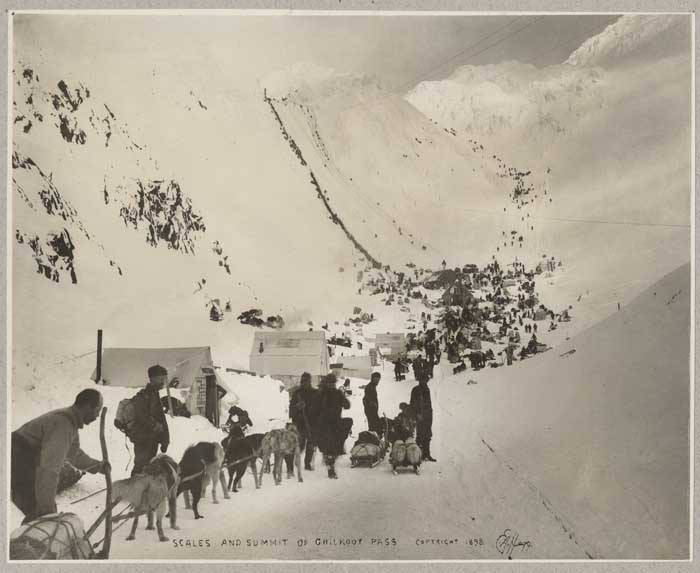
Gold is found on the Klondike in mid-August 1896. On 17 July 1897 the Portland docks in Seattle with 68 prospectors and, as the newspapers put it, “a ton of gold”. The rush begins.
Canada lets no one across the border without supplies: everyone must bring a year's supply of goods, the “ton of goods”. The list includes “Two picks and one shovel” and a gold pan for each person. Seattle's Chamber of Commerce promotes the city as the “only place” to outfit.
Even the route is a business. George Brackett charges 75 cents per pound on his wagon road over the White Pass. On 29 July 1900 the railway over the pass is finished, 110 miles to Whitehorse.
Only some find gold. By August 1898 many head home, “most of them broke”. Many sell their gear and supplies to pay for the trip back.
In Dawson City and Seattle more fortunes were made off miners than by mining.
U.S. National Park Service, Klondike Gold Rush National Historical Park
Then and now: the same principles
| Klondike 1897 | Network programme 2026 | What that means |
|---|---|---|
| Gold veins: who strikes it is open | Corridors and projects: 13 instead of 21 renewals by 2031, the rest postponed | Betting on a single project means carrying its schedule and delivery risk. |
| Mandatory outfit: a year's supply | Mandatory equipment: ETCS on track and vehicle, 740 m trains, 22.5 t axle load | Using the network requires suitable equipment – whichever corridor is finished first. |
| 70,000 customers of Seattle's merchants | Owners and lessors of containers, swap bodies, wagons and locomotives | They earn from use of the network, not from a single strike. |
| Toll on the White Pass: 75 cents per pound | Track access charges and truck toll | The route costs money. In 2026 the federal government budgets €265 m to reduce rail freight track access charges. |
| Railway instead of pack trail, finished 1900 | General renewal, expansion, terminals | The stated aim: more freight from road to rail. |
| Gear is resold | Secondary market for standardised units | Standardised assets change users. Their price then depends on condition and demand. |
The advantages of mobile assets
Why it matters: the network stays where it is built. Loading units, wagons and locomotives go where they are needed.
Network-neutral
A container does not ask which corridor is finished first. Every renewed line, every terminal and every longer train widens where it can work.
Mobile
If demand is elsewhere, the asset moves there. A bridge pier stays where it stands.
Standardised
ISO 6346 and EN 284 fix dimensions and codes. Every user of the same standard can take the unit over.
Long-lived
Containers 13 to 20 years, freight wagons a 25 to 35-year life cycle according to UIP – longer than a funding programme or a renewal wave.
Predictable for tax
Germany's official depreciation table sets 10 years for transport containers, 11 for swap bodies and 25 for rail vehicles.
Supported in use
In 2026 the federal government budgets €265 m for lower track access charges, €300 m for single wagonload and €90.3 m for combined transport facilities.
What that means: the assessment in the cards is ours. Every figure comes from the sources at the foot of the page.
The mapping: decision → mobile asset
What the federal government and the EU have decided or proposed, and which moving parts of the system it affects.
| Decision | What it requires or funds | Mobile assets affected | In the library |
|---|---|---|---|
| General renewal: 13 corridors 2027–2031 (BMV, 9 Oct 2026) | Full closures; for Lehrte – Berlin a second diversion route for freight | Locomotives for diversions, including over non-electrified sections | Vectron Dual Mode |
| Economic plan 2026: €2.45 bn ERTMS | Equipping infrastructure and “rolling stock (trains, wagons)” | Locomotives with ETCS on-board units | Vectron MS · Traxx 3 MS |
| TEN-T Regulation (EU) 2024/1679 | 740 m freight trains, 22.5 t axle load, clearance for 4 m high trailers | Container and pocket wagons | Sggmrss 90' · T3000e |
| Federal budget section 12, 2026 | CT facilities €90.3 m, sidings €30 m, track access charges €265 m, single wagonload €300 m | Containers, swap bodies, container wagons, single-wagonload freight wagons | Sgns 60' · Eanos |
| StVZO § 34, StVO § 30, KraftStG § 3 | 44 t, exemption from the Sunday ban, no vehicle tax for pre- and on-carriage | Containers, swap bodies, craneable semi-trailers | Swap body C · 40' HC |
| Proposed Combined Transport Directive, 2023/0396(COD) | Support for operations with at least 40% lower external costs than road-only | Loading units in combined transport | 45' HC |
| Capacity Regulation (EU) 2026/1184 | European coordination of train paths; “around 50% of rail freight crosses borders” | Multi-system locomotives for cross-border traffic | Vectron MS |
| Military mobility (Commission) | “Transport capabilities, such as flatbed wagons and Ro-Ro ferries, remain scarce.” | Flat wagons | Sgns 60' · Sggmrss 90' |
What that means: the “mobile assets affected” column is our mapping. Siemens itself says of the dual-mode locomotive: “seamless operation even on partially electrified routes”.
Shovels carry risks too
- Utilisation varies. Triton reports ending utilisation of 97.1% for 2025, after 99.1% a year earlier.
- Short leases, long assets. The average remaining lease term of GATX's European fleet was about 26 months at end-2025 – against useful lives of 32 to 40 years. Re-leasing decides.
- Customer concentration. At GATX Rail Europe one customer accounted for about 17% of lease revenue in 2025.
- Technology change. The switch to “ETCS Level 2 without signals” “can take place once the vehicle fleets have largely been retrofitted” (BMV, own translation). Vehicles without the equipment then lose scope.
- Obligations. Containers must be examined regularly under the CSC. Ownership is not passive possession.
- The Klondike lesson. Many stampeders had to sell their gear to get home. A secondary market can come under pressure.